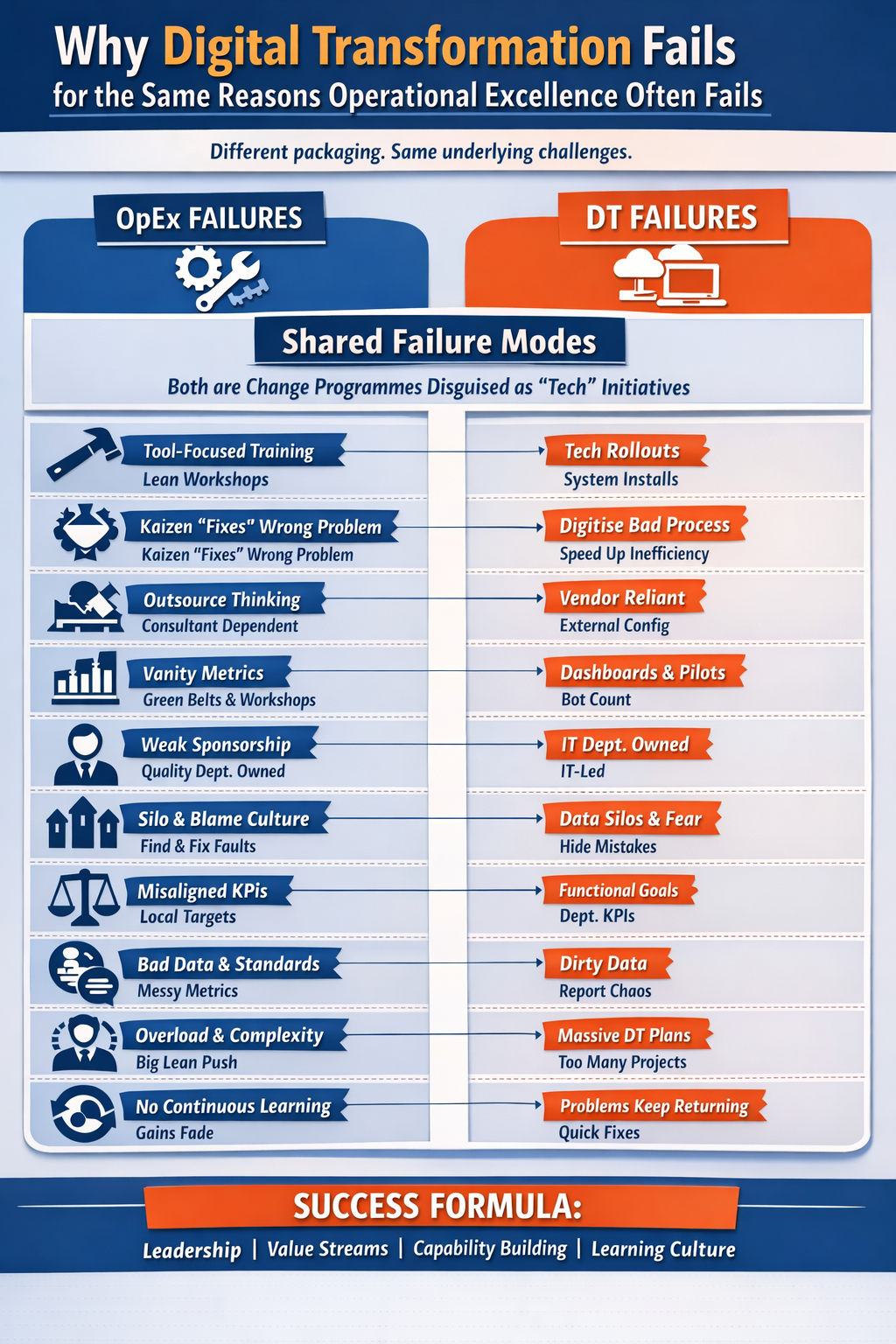
If you’ve worked through a Lean rollout, a Six Sigma deployment, an ERP implementation, a MES upgrade, or a shiny new “AI-enabled” initiative, you’ve probably felt an uncomfortable déjà vu: the slide decks change, the buzzwords evolve, but the failure patterns repeat.
Digital Transformation (DT) and Operational Excellence (OpEx) are frequently treated as different “programmes.” In practice, they fail in remarkably similar ways—because both are organisational change programmes disguised as technical or methodological upgrades.
Below are the most common shared failure modes, why they happen, and what to do differently.
1) Treating the initiative as a tool rollout instead of a behaviour change programme
OpEx failure pattern: “We trained everyone in Lean/Six Sigma.”
DT failure pattern: “We implemented the platform.”
In both cases, leadership often equates deployment with adoption. But competence and behaviour don’t change because a tool exists or because a badge was earned. Sustainable improvement requires changes in routines, decision rights, problem-solving habits, and how performance is managed.
What it looks like:
- Lean boards updated for audits, not for daily management
- Dashboards built, but decisions still made by gut feel or hierarchy
- New systems used as “data entry” while old spreadsheets remain the real process
Do differently: Define the new standard work for leaders and teams (daily huddles, tiered meetings, escalation, problem-solving cadence) before you scale tools.
2) Digitising or optimising a broken process (automation of waste)
OpEx failure pattern: Kaizen events “improve” a process no one has properly mapped end-to-end.
DT failure pattern: Automation makes a bad process faster and harder to change.
DT can amplify inefficiency. OpEx can institutionalise local optimisation. Both are vulnerable to solving the wrong problem beautifully.
What it looks like:
- “We automated approvals” (but the approval chain is unnecessary)
- “We reduced cycle time” (but created more defects downstream)
- “We implemented eBR/MES” (but the workflow is designed around legacy paperwork)
Do differently: Start with value-stream thinking and root cause. If you wouldn’t standardise it, don’t digitise it.
3) Outsourcing core capability and losing organisational learning
OpEx failure pattern: Consultants run the programme; internal teams watch.
DT failure pattern: Vendors configure systems; internal teams become ticket raisers.
External partners can accelerate progress—but when the thinking is outsourced, you build dependency. The organisation doesn’t learn how to diagnose problems, design solutions, or continuously improve the new system.
What it looks like:
- “We need the consultants back” to sustain results
- Super-users are few and overworked; knowledge sits in one person’s head
- Any change request becomes slow, expensive, and political
Do differently: Treat every project as a capability-building project: internal product owners, internal process engineers, internal data stewards—paired with partners, not replaced by them.
4) Measuring activity instead of outcomes (vanity metrics)
OpEx failure pattern: Count green belts, projects, training hours.
DT failure pattern: Count dashboards, bots, use-cases, pilots.
You can hit all your delivery milestones and still fail to move business performance. Both programmes often become “portfolio theatre.”
What it looks like:
- Lots of pilots; little scaled value
- “Savings” claimed but not realised in financials
- Dashboards that are impressive but not used in daily decisions
Do differently: Tie each initiative to a small set of outcome metrics (quality, lead time, yield, right-first-time, OEE, service levels, deviation recurrence, cost-to-serve) and track adoption metrics that prove behaviour change (decision latency, % decisions made with data, adherence to standard work).
5) Weak sponsorship and “delegated leadership”
OpEx failure pattern: The quality/CI department “owns” excellence.
DT failure pattern: IT “owns” transformation.
Both fail when executives sponsor in name only and delegate the hard parts—trade-offs, priorities, resourcing, and accountability.
What it looks like:
- Middle management fights the programme because incentives don’t change
- Teams are asked to transform on top of their day job with no capacity
- Projects stall when decisions require cross-functional alignment
Do differently: Make it a business programme with clear decision rights, capacity allocation, and leader standard work. If the operating model doesn’t change, the initiative won’t stick.
6) Culture clash: local optimisation, silos, and blame
OpEx failure pattern: Improvement becomes “find who messed up.”
DT failure pattern: Data becomes weaponised; people hide problems.
Continuous improvement and digital transparency can feel threatening in blame cultures. People protect themselves: data quality drops, issues get buried, “workarounds” appear.
What it looks like:
- Teams game KPIs
- People avoid raising deviations because it creates extra work or scrutiny
- Data is distrusted because it’s incomplete, inconsistent, or politically contested
Do differently: Build psychological safety and a learning culture. Treat problems as signals, not personal failures. Reward surfacing issues early.
7) Not aligning incentives, governance, and operating rhythm
OpEx failure pattern: Lean says “flow,” finance says “utilisation.”
DT failure pattern: Digital says “end-to-end,” departments say “my KPI.”
When incentives contradict the transformation logic, teams do what they’re rewarded to do—regardless of the programme messaging.
What it looks like:
- Departments prioritise their metric even when it harms the value stream
- Digital initiatives fail because data ownership crosses functions
- OpEx projects die when savings can’t be “owned” by one cost centre
Do differently: Redesign KPIs around value streams and customer outcomes. Clarify ownership: process owners, data owners, and product owners with authority.
8) Poor data and weak standardisation (garbage in, garbage out)
OpEx failure pattern: Measurement systems can’t detect meaningful change.
DT failure pattern: Systems produce reports no one trusts.
OpEx relies on stable processes and reliable measurement. DT relies on standardised definitions and clean data. Both collapse when foundational discipline is missing.
What it looks like:
- Endless debates about “what the number really means”
- Multiple sources of truth
- Improvement work based on noisy or biased data
Do differently: Fix measurement and definitions early: master data governance, common KPIs, validated data pipelines, and basic process standardisation.
9) Over-complexity: trying to transform everything at once
OpEx failure pattern: Big-bang Lean transformation across the whole plant.
DT failure pattern: “Enterprise digital transformation” with 100 initiatives.
Scale without focus creates fatigue. People experience transformation as disruption, not improvement—then resistance becomes rational.
What it looks like:
- Initiative overload and competing priorities
- Too many tools, too many standards, too many “owners”
- Teams stop believing anything will last
Do differently: Pick a small number of high-value value streams. Deliver measurable outcomes fast. Then scale with a repeatable playbook.
10) No closed-loop learning: projects finish, problems return
OpEx failure pattern: Gains disappear after the kaizen event.
DT failure pattern: The solution goes live; incidents and workarounds proliferate.
Both fail when the organisation lacks a mechanism to learn and adapt continuously.
What it looks like:
- “Sustainment” is a slide, not a system
- Control plans exist, but nobody follows them
- Digital releases happen, but nobody measures impact and iterates
Do differently: Establish a true continuous improvement loop: monitor → learn → adjust → standardise. Treat digital products as living systems with ongoing ownership.
The Core Insight: DT and OpEx Fail When They’re Not Treated as the Same Thing
Digital Transformation without Operational Excellence is often just digitised chaos.
Operational Excellence without Digital enablement can be manual discipline that struggles to scale.
They are complementary—but the reason they fail is shared: both require leadership, operating model changes, capability building, and a learning culture.
A Practical “Anti-Failure” Checklist (Works for Both DT and OpEx)
- Start with a value stream, not a department.
- Fix the problem statement before selecting tools.
- Define new standard work for leaders and teams.
- Build internal capability (don’t outsource the thinking).
- Measure outcomes + adoption, not activity.
- Align KPIs and incentives across functions.
- Establish data and process foundations early.
- Deliver a few wins fast, then scale deliberately.
- Create a closed-loop learning system with clear ownership.
- Treat it as cultural change, because it is.
Closing thought
If you want a simple way to explain the similarity:
Operational Excellence fails when organisations try to install “Lean” without changing how people lead and work.
Digital Transformation fails when organisations try to install “Digital” without changing how people lead and work.
Different packaging. Same underlying challenge.