
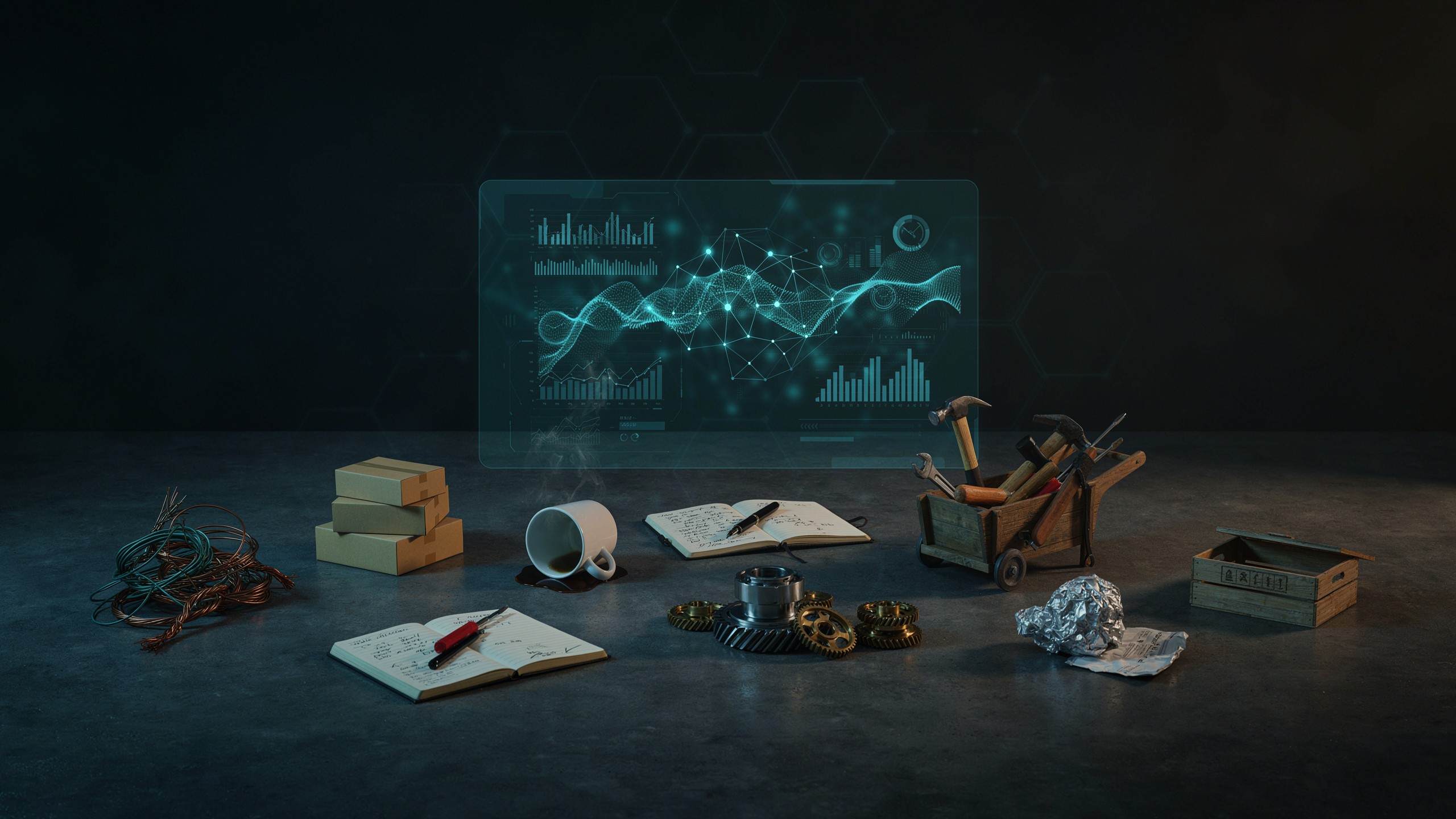
Lean practitioners have spent decades looking for waste. The traditional eight wastes—defects, overproduction, waiting, non-utilised talent, transportation, inventory, motion and extra processing—gave organisations a practical language for identifying activities that consume resources without creating value.
But what happens when work becomes digital and increasingly supported by Artificial Intelligence?
The eight wastes have not disappeared. In many cases, they have simply changed form.
A queue of physical paperwork becomes a queue of digital approvals. Excess inventory becomes thousands of unused files and reports. Rework becomes repeatedly correcting AI-generated output. Unnecessary motion becomes employees moving between multiple applications. Overproduction becomes AI generating more content, reports and analysis than anybody actually needs.
AI can remove enormous amounts of waste.
But it can also create waste at a scale and speed we have never experienced before.
Perhaps it is time to revisit the eight wastes for the age of AI.
1. Defects become bad data and bad decisions
Traditionally, defects meant products or services that did not meet requirements. Defects created scrap, rework, complaints and additional cost.
In an AI-enabled process, the definition becomes broader.
A defect might be inaccurate source data, an incorrect AI-generated answer, a poorly classified case, an inappropriate recommendation or a decision made using incomplete information.
The danger is that AI can scale defects very quickly.
A person making one incorrect decision creates one problem. An automated system repeatedly applying flawed logic can create thousands.
This makes the quality of inputs increasingly important. If AI is operating on inconsistent, incomplete or badly governed data, the problem is not simply poor data quality. It becomes a process-quality problem.
The old principle still applies:
Quality must be built into the process, not inspected afterwards.
2. Overproduction becomes content overload
AI makes producing information extraordinarily easy.
Reports can be generated instantly. Emails can be drafted in seconds. Presentations, summaries, analyses and documents can be created at almost zero marginal effort.
That sounds like productivity.
But Lean would ask a different question:
Does anybody need it?
If AI allows us to produce ten reports where previously we produced two, but nobody uses the additional eight to make a decision, we have not increased productivity.
We have increased overproduction.
This may become one of the biggest forms of digital waste in the AI era: organisations generating more information simply because they can.
More reports.
More dashboards.
More presentations.
More emails.
More analysis.
The ability to create information is increasing much faster than our ability to consume it.
The Lean question remains remarkably relevant:
Only produce what is needed, when it is needed, in the quantity required.
3. Waiting becomes decision latency
Waiting has always been one of the easiest wastes to recognise. Material waits between operations. Customers wait for service. Documents wait for approval.
Digital systems were supposed to remove much of this waiting.
Yet many organisations have simply created digital queues.
A request is submitted electronically and then waits three days for approval. A workflow automatically sends a notification, but the decision still waits. A dashboard highlights an issue immediately, but nobody has clear responsibility for acting on it.
AI can potentially reduce this waste by analysing information, prioritising cases and supporting faster decisions.
But the real constraint is often not technology.
It is unclear decision rights.
Who can decide?
What information is required?
What level of risk requires escalation?
AI can make information available instantly, but if the organisation still requires six approvals, the process remains slow.
The modern form of waiting is therefore increasingly decision latency.
4. Non-utilised talent becomes human potential trapped in administration
This may be the waste where AI offers the greatest opportunity.
Across many organisations, highly skilled people spend significant portions of their working day searching for information, preparing reports, scheduling meetings, copying data, formatting documents, answering repetitive questions and performing routine administrative activities.
A scientist should be doing science.
An engineer should be solving engineering problems.
A nurse should be caring for patients.
A lecturer should be teaching, supporting learners and developing knowledge.
Yet organisations often surround these roles with increasing amounts of administration.
AI creates an opportunity to remove some of that burden.
But there is an important warning.
The objective should not simply be to automate people’s jobs. It should be to release people’s capability.
If AI saves somebody five hours per week, the important question becomes:
What higher-value work can that person now do?
Otherwise, we have measured time savings without actually creating value.
5. Transportation becomes unnecessary information movement
Traditional transportation waste involves unnecessarily moving materials from one place to another.
In knowledge work, the equivalent is often information moving unnecessarily between systems, functions and people.
A piece of information is entered into one system, exported into Excel, emailed to somebody, copied into another system and eventually summarised into a PowerPoint presentation.
The information has travelled extensively.
It may not have become any more valuable.
AI can potentially connect and interpret information across multiple sources, reducing this digital transportation.
But poorly implemented AI can also make it worse. Organisations may create new AI platforms that sit on top of existing systems without solving the underlying integration problem.
The modern question becomes:
Why is this information moving at all?
Ideally, information should exist once, be trusted, and be available where it is needed.
6. Inventory becomes information inventory
In manufacturing, excess inventory ties up capital and hides problems.
Digital organisations have developed their own version.
Documents nobody reads.
Reports nobody uses.
Thousands of emails.
Duplicate files.
Old versions of procedures.
Unused dashboards.
Data collected because somebody once thought it might be useful.
AI makes this particularly interesting because organisations increasingly want to make all of this information available to intelligent systems.
But more information is not automatically better information.
Poorly structured knowledge creates noise.
The future challenge will not simply be storing information. It will be deciding what information should be retained, trusted, governed and made available to AI.
We therefore need to think about information inventory in the same way Lean thinks about physical inventory.
Too much can hide problems rather than solve them.
7. Motion becomes digital motion
Traditional motion waste refers to unnecessary physical movement by people.
In modern knowledge work, much of that movement happens digitally.
Open one application.
Copy the information.
Switch to another application.
Search for the correct file.
Open an email.
Find the attachment.
Log into another system.
Copy the data again.
Return to the original application.
We may not be walking across a factory floor, but we are still moving unnecessarily.
This is digital motion.
AI agents and integrated workflows have enormous potential to reduce this waste by finding information, moving between systems and completing routine activities on behalf of users.
But again, we should first ask why so many disconnected steps exist.
The goal should not be to build an AI agent capable of navigating twenty badly connected systems.
It should be to design a better workflow.
8. Extra processing becomes intelligent overprocessing
Extra processing occurs when we do more work than the customer or process actually requires.
AI could make this waste explode.
A simple question receives a three-page response.
A short report becomes a 40-page document.
Every meeting gets transcribed, summarised, categorised and stored.
Every dataset gets analysed because analysis is now cheap.
Every document receives an AI-generated executive summary whether anybody needs it or not.
This is intelligent overprocessing.
The technology is doing exactly what we asked.
The problem is that we never asked whether the work needed to be done.
AI reduces the cost of producing work, but that does not mean the work has value.
Lean thinking therefore becomes even more important.
Before asking AI to do something, ask:
Does this activity need to exist?
Is there now a ninth waste?
Perhaps AI introduces another form of waste that deserves its own category:
Unnecessary Intelligence.
This occurs when AI is applied simply because it is available rather than because the process requires it.
An organisation implements an AI solution where a simple workflow rule would work better.
A sophisticated model is developed to solve a problem that could have been eliminated through process redesign.
An AI agent automates ten steps when six of those steps should not exist.
This is technology looking for a problem.
And it may become one of the defining wastes of the AI era.
Lean thinking may become more important, not less
There is a temptation to view Lean as belonging to an earlier industrial age and AI as representing its replacement.
I think the opposite may be true.
AI dramatically increases our ability to perform work.
Lean helps us decide which work should be performed at all.
That distinction is crucial.
As the cost of generating information, analysing data and automating activities falls, organisations will need stronger disciplines for distinguishing value from activity.
The question will no longer be:
Can we automate this?
Increasingly, it should be:
Should this exist?
Then:
Can we simplify it?
And only then:
Should a person, conventional automation or AI perform it?
The eight wastes are evolving
The eight wastes in an AI-enabled organisation might therefore look something like this:
Defects → Bad data and bad decisions
Overproduction → Content and information overload
Waiting → Decision latency
Non-utilised talent → Human capability trapped in administration
Transportation → Unnecessary movement of information
Inventory → Information and knowledge inventory
Motion → Digital motion between systems
Extra processing → Intelligent overprocessing
And perhaps:
The ninth waste → Applying AI where it adds no value
The terminology may have changed.
The underlying Lean principle has not.
Conclusion
AI has the potential to remove enormous amounts of waste from organisations. It can reduce administration, accelerate analysis, improve access to knowledge and automate repetitive work.
But it can also produce waste faster than we have ever seen before.
It can generate unnecessary content, automate unnecessary processes, amplify poor decisions and add intelligence to activities that should simply have been eliminated.
That is why Lean thinking remains so relevant in the age of AI.
Before applying AI, understand the process.
Before automating the process, remove the waste.
Before generating more information, understand who needs it.
And before asking whether AI can perform an activity, ask the most important Lean question of all:
Does this activity create value in the first place?
AI may change how work is performed.
It does not change the need to distinguish value from waste.