
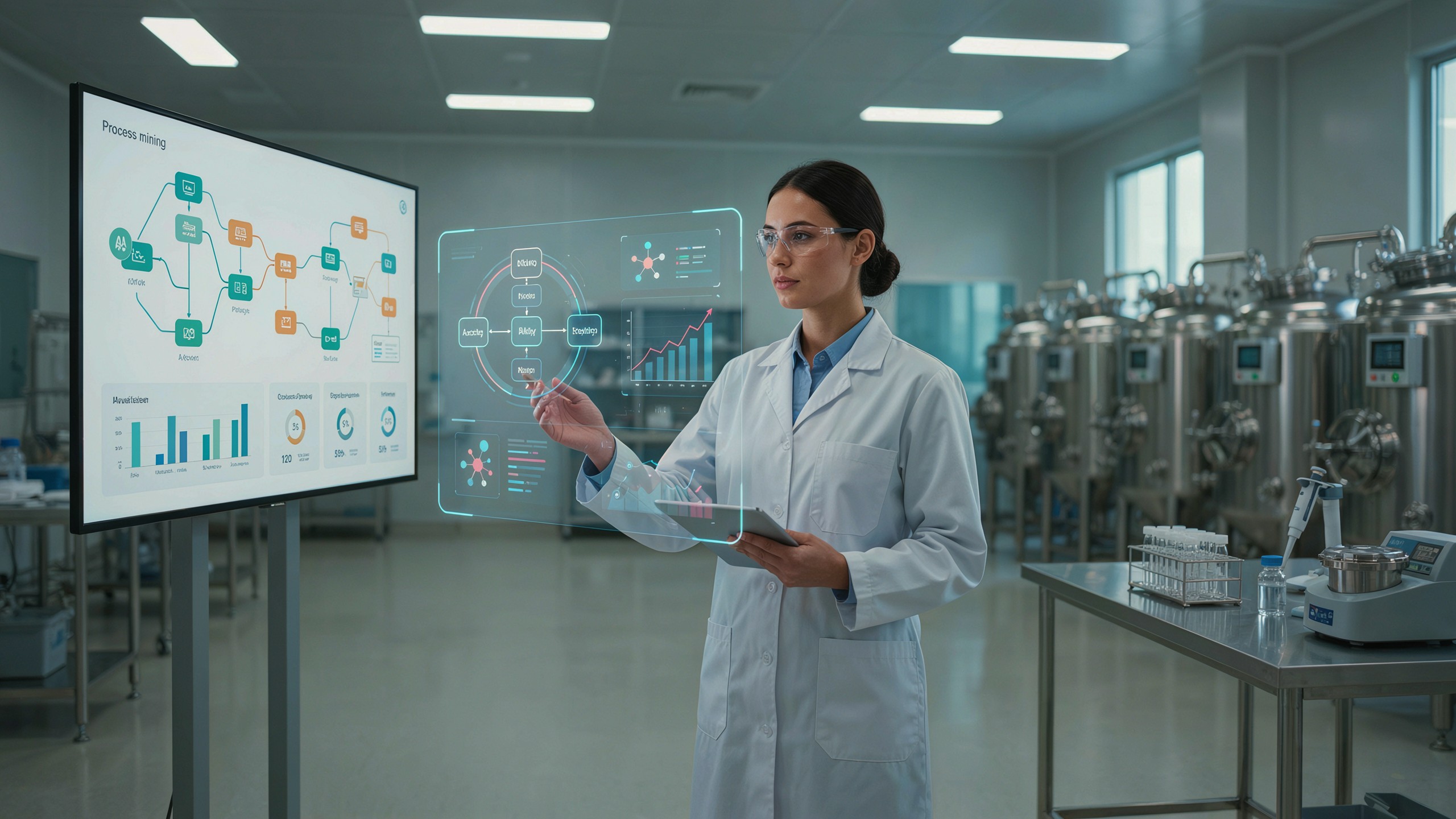
Pharmaceutical companies have enormous amounts of quality data.
Deviations, CAPAs, complaints, change controls, audit observations, laboratory investigations and validation records generate thousands of transactions.
Yet many organisations still struggle to answer a surprisingly basic question:
How does our quality process actually work?
The SOP describes the intended process.
Process mining can show the real one.
By analysing event logs from digital quality systems, process mining can reconstruct how cases actually move through the workflow. It can show where investigations wait, where cases are repeatedly returned for additional information, which process variants take longest and where approvals create bottlenecks.
That is already powerful.
Combine it with AI and the opportunity becomes much more interesting.
Process mining tells us what is happening.
AI can help us explore why it may be happening.
Imagine identifying that one category of deviation takes 40% longer to close than comparable cases. Process mining identifies the delay. AI analyses the associated records and identifies recurring characteristics: incomplete initial descriptions, repeated requests for laboratory information and a particular approval sequence.
Now the improvement team has a focused problem to investigate.
The same approach could be applied to CAPA effectiveness, complaints, change control or validation workflows.
This changes Process Excellence in Quality.
Instead of improvement teams periodically mapping processes through workshops, the organisation can increasingly maintain a living picture of how its quality processes actually behave.
The opportunity is not to automate Quality blindly. It is to create process intelligence.
A mature pharmaceutical quality system should increasingly be able to answer:
What is happening?
Where is work waiting?
Which process pathways perform best?
Where is rework occurring?
Which patterns are emerging?
Where should we investigate next?
Process mining provides the visibility.
AI provides additional analytical capability.
Human Quality professionals provide the context, scientific judgement and accountability.
Together, they could turn the pharmaceutical quality system from a repository of historical records into something far more valuable:
a continuously learning system.