
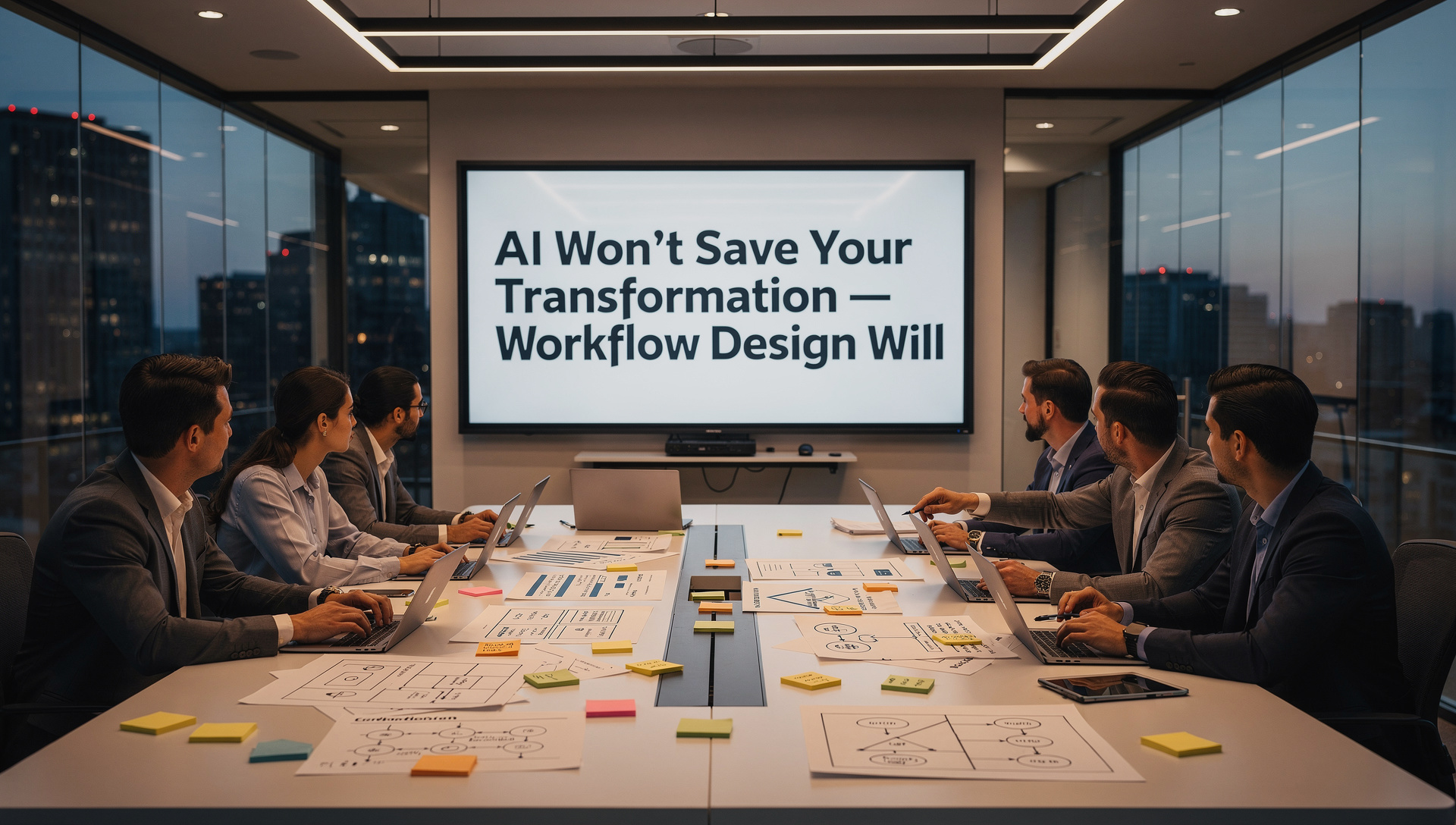
Artificial Intelligence is dominating the digital transformation agenda. Organisations are investing heavily, running pilots, and exploring use cases across every function. The promise is compelling: faster decisions, greater efficiency, better insights, and reduced manual effort. Yet despite all of this activity, many organisations are beginning to recognise a difficult truth—AI is not fixing their business. In many cases, it is simply exposing the problems that were already there. This is because AI does not operate in isolation; it operates within the structure of how work gets done. If that structure is weak, unclear, or inefficient, AI will not solve it. It will amplify it.
The fundamental issue is that most digital transformation challenges are not caused by a lack of intelligence or technology. They are caused by poor workflow design. In many organisations, work still moves through fragmented processes, unclear ownership, duplicated checks, and slow, inconsistent decision-making. These issues create delays, rework, and a constant reliance on escalation and firefighting. When AI is introduced into this environment, it does not magically create clarity or flow. Instead, it struggles to integrate, produces outputs that are mistrusted, or gets bypassed entirely by people who revert to familiar ways of working. The technology may function perfectly, but the system it is placed into does not.
This is why so many AI initiatives fail to scale. They succeed technically but fail operationally. The model works, the pilot delivers results, and the demonstration is impressive, but the organisation does not change. The reason is simple: the AI has not been embedded into a well-designed workflow. It sits alongside the work rather than becoming part of it. As a result, it has no real influence on how decisions are made or how value is created. Organisations end up with pockets of innovation rather than meaningful transformation.
The organisations that are seeing real value from AI are approaching the problem differently. They are not starting with the question, “Where can we apply AI?” Instead, they are asking, “Where does work break down, and how should it be redesigned?” They focus on the flow of work end to end—where decisions happen, where delays occur, where ownership is unclear, and where data is disconnected from action. They simplify processes, reduce unnecessary steps, clarify decision points, and ensure that data supports the workflow rather than complicates it. Only then do they introduce AI, placing it precisely where it can enhance decision-making, automate repetitive activity, or surface insights at the right moment.
This shift from an AI-first mindset to a workflow-first mindset is critical. It recognises that technology is an enabler, not a solution. AI can enhance a strong system, but it cannot rescue a weak one. If the workflow is poorly designed, AI will either fail within it or accelerate its inefficiencies. If the workflow is well designed, AI can deliver significant gains in speed, consistency, and performance. The difference lies not in the sophistication of the technology, but in the quality of the underlying design.
There is also a human dimension to this challenge that is often overlooked. Workflows are not just technical constructs; they are lived experiences for the people who operate within them. If a process is confusing, overloaded with steps, or disconnected from how work actually happens, people will find ways around it. Introducing AI into that environment without addressing usability and trust only increases resistance. People need to understand how AI fits into their work, when to rely on it, and when to challenge it. Without that clarity, adoption remains low and value is never fully realised.
The growing focus on AI is therefore pushing organisations toward a more fundamental realisation: digital transformation is not about deploying smarter tools; it is about designing better systems of work. Workflows are becoming the true operating system of the organisation. They determine how decisions are made, how information flows, how people collaborate, and how technology is used. If those workflows are well designed, digital investments compound in value. If they are not, even the most advanced technology struggles to deliver meaningful impact.
The implication is clear. Organisations need to stop asking how AI can fix their problems and start asking how their work should be redesigned. That means stepping back from the technology and examining the fundamentals: how work flows, who owns outcomes, where decisions are made, and how data supports those decisions. It means simplifying before automating, clarifying before digitising, and designing before deploying. Only then does AI become truly powerful.
AI will undoubtedly transform how organisations operate, but it is not a shortcut to transformation. It is a force multiplier. It will amplify whatever system it is placed into—for better or for worse. The organisations that succeed will not be the ones that deploy the most AI, but the ones that design how work gets done in a way that allows AI to make a meaningful difference. In that sense, the future of digital transformation will not be defined by technology alone. It will be defined by the quality of the workflows that technology is built upon.