
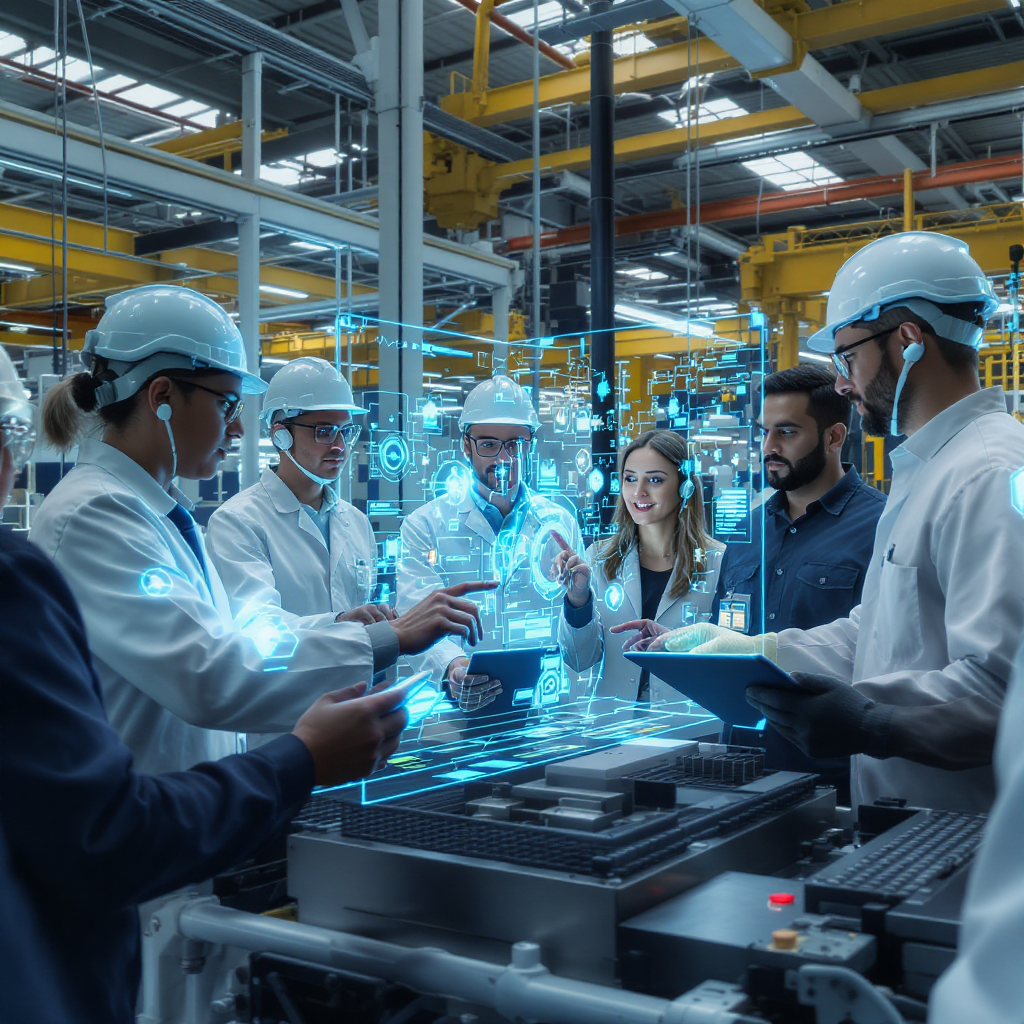
Digital transformation in manufacturing is often described in terms of technology: automation, AI, sensors, MES, digital twins, robotics, predictive maintenance, advanced analytics, and connected supply chains. These tools matter. But they are not the transformation.
The real test of digital transformation is whether people can use technology to improve how work is done. If the workforce is confused, excluded, overloaded, or underprepared, even the best systems will struggle to create value. That is why the human side of digital transformation is no longer a soft issue sitting beside the technical programme. It is central to whether the programme succeeds at all. The European Commission’s Industry 5.0 framing places the wellbeing of the worker at the centre of production, while recent McKinsey and World Economic Forum work continues to highlight skills, frontline capability, and usability as critical to manufacturing transformation.
Technology does not transform a factory on its own
Many manufacturing organisations still talk about transformation as though technology is the main event and people are the adoption challenge that follows. In practice, the opposite is often true. The technical solution may be well specified, well funded, and well implemented, yet the organisation still fails to realise value because workers do not trust the system, leaders do not change how decisions are made, and frontline teams are expected to operate in a new environment without enough support. McKinsey’s January 2026 analysis argues that tech investments will not pay off in higher frontline productivity unless companies invest in worker capabilities, while the World Economic Forum continues to identify skills disruption and reskilling as major features of the next phase of work.
This is especially important in manufacturing because digital transformation changes real work, not just office workflows. It affects how operators respond to alarms, how supervisors make decisions, how maintenance teams interpret signals, how quality data is recorded, how deviations are investigated, and how managers understand performance. When transformation changes the experience of work, it becomes a human issue immediately.
The frontline is where digital transformation becomes real
A common weakness in digital transformation programmes is that they are designed too far away from the production floor. Systems are selected, workflows are modelled, dashboards are built, and future-state processes are defined, but the lived reality of operators and technicians is not fully understood. Then the organisation is surprised when adoption is weak or workarounds appear.
The frontline is not just the end user of digital transformation. It is the place where transformation either becomes operational reality or collapses into friction. McKinsey’s work on manufacturing and frontline talent argues that companies leading in productivity and stability are treating people strategy as central to operations strategy, not as a separate HR concern.
That means the human side of digital transformation starts with respecting operational knowledge. Operators often know where systems are likely to fail in practice, where data entry will become awkward, where alerts will be ignored, where handoffs are unclear, and where the formal process does not match the real one. Ignoring that knowledge is one of the fastest ways to turn digital investment into digital waste.
Skills are now part of the production system
For a long time, manufacturers treated skills as something adjacent to performance. In the digital era, skills are part of performance.
If a factory introduces AI-enabled tools, advanced automation, digital quality systems, or connected planning platforms, the workforce must be able to interpret outputs, respond correctly, and make sound decisions in a more data-rich environment. McKinsey’s 2026 article is explicit that frontline productivity gains from AI depend on capability-building before broad deployment. The World Economic Forum’s Future of Jobs Report 2025 similarly reports that employers expect major changes in workers’ core skills by 2030.
This does not only mean formal technical training. It includes digital confidence, problem-solving, data interpretation, system awareness, and the judgement to know when to trust a tool and when to question it. In manufacturing, this blend of human judgement and digital fluency is becoming a core operational capability rather than a specialist one.
Usability is a people issue, not just a design issue
Digital transformation often gets slowed down by what companies describe as a skills gap. Sometimes that is true. But sometimes the problem is that the tools are simply not designed around real users.
The World Economic Forum noted in 2025 that poor usability in manufacturing technology can itself become a major barrier to transformation, and that poorly designed tools make digital adoption harder while also contributing to talent frustration and retention problems.
This matters because bad usability creates hidden operational waste. Workers duplicate entries, keep shadow spreadsheets, avoid systems, delay updates, or rely on tribal knowledge to bypass awkward digital flows. The result is that the company ends up paying for both the official system and the unofficial workaround. A factory is not more advanced because it has more screens. It is more advanced when digital tools genuinely make work clearer, faster, safer, and easier to control.
Change fatigue is real on the shop floor
Manufacturing workers are often asked to absorb change while still hitting output, quality, safety, and delivery targets. New interfaces, new reporting routines, new escalation paths, new device usage, new data expectations, and new cross-functional processes all arrive while the line still has to run.
That creates a serious human challenge. Digital transformation can easily feel like additional burden rather than operational improvement if it is layered on top of existing pressures without thoughtful change design. McKinsey’s recent work on radical reinvention argues that traditional change tools are often insufficient for the scale and complexity of modern transformation.
In manufacturing environments, that means leaders cannot assume that communication alone equals change management. People need clarity, involvement, coaching, space to learn, and visible evidence that the new way of working actually helps. Otherwise, the workforce may comply on paper while quietly resisting in practice.
Human-centred manufacturing is not anti-technology
Talking about the human side of transformation does not mean resisting automation or romanticising manual work. It means understanding that technology should elevate human performance, not sideline it.
That is consistent with the Industry 5.0 vision, which frames the future of industry as human-centric, sustainable, and resilient. The point is not to slow technological progress. It is to ensure that progress improves the wider system, including worker wellbeing and adaptability.
In practical terms, that means asking different questions during transformation:
How will this tool change the operator’s day?
What decisions will become easier?
What new risks will appear?
What skills will be required?
What support will supervisors need?
How will we know whether the technology is helping people perform better, not just generating more data?
Those questions make the programme stronger, not softer.
Leadership behaviour matters as much as system capability
Factories do not become digitally mature because software is installed. They become digitally mature when leaders use technology to improve decisions, empower teams, and solve problems in better ways.
If leaders continue to manage through blame, narrow targets, weak escalation, and superficial reporting, digital tools can actually make things worse by amplifying noise and pressure. If, on the other hand, leaders use digital visibility to coach, prioritise, learn, and collaborate across functions, technology becomes an enabler of a better operating culture. McKinsey’s operations commentary for 2025 highlights the importance of cross-functional collaboration and curiosity in capturing productivity gains from technology.
This is why the human side of digital transformation is also a leadership issue. The workforce watches how leaders react to data, how they respond to mistakes, how they involve teams, and whether digital systems are being used for learning or only for control. That cultural signal shapes adoption more than many formal rollout plans.
The best digital factories build confidence, not fear
Some transformation programmes unintentionally create anxiety. Workers may worry that automation will reduce their value, that digital systems will expose every error, or that they are being left behind by technology they were never properly prepared to use.
The better response is not vague reassurance. It is credible investment in people. Recent WEF and McKinsey work points toward reskilling, practical learning environments, and intentional frontline development as essential elements of the new manufacturing model. WEF’s production-line learning examples in late 2025 described digital learning hubs and simulation-first “training dojos” located close to the workplace so people can build confidence in realistic conditions.
That approach matters because confidence is operational. People who feel capable are more likely to use tools properly, raise issues early, interpret signals better, and contribute improvement ideas. Human-centred transformation is not only about kindness. It is about performance.
What manufacturers should do differently
Manufacturers that want digital transformation to succeed should treat people as part of the system design, not as recipients of the finished solution. That means involving frontline users earlier, simplifying interfaces, building digital capability deliberately, training supervisors as much as operators, measuring usability and adoption, and giving visible attention to the experience of work as systems change. Those priorities are aligned with the direction of current manufacturing and Industry 5.0 thinking across the European Commission, McKinsey, and the World Economic Forum.
It also means recognising that people strategy is no longer separate from factory strategy. In digitally enabled manufacturing, workforce capability, learning design, leadership behaviour, and system usability are all part of operational excellence.
Conclusion
The human side of digital transformation in manufacturing is not the softer side of the agenda. It is the side that determines whether the agenda works.
Technology can connect machines, automate workflows, and generate insight. But people still decide, adapt, respond, escalate, learn, and improve. If transformation ignores that reality, manufacturers may install impressive systems without achieving meaningful change. If they embrace it, they can build factories that are not only smarter, but more capable, more resilient, and more human. That is much closer to what modern manufacturing should be aiming for.