

Most people want better answers.
Fewer people focus on better questions.
That is a mistake, because the quality of your thinking is often shaped by the quality of the questions you ask. Intelligent questions help you see clearly, challenge weak assumptions, and get closer to what is actually true. They slow down bad decisions and improve good ones.
Critical thinking works the same way. It is not about sounding clever or being skeptical about everything. It is about examining ideas carefully, testing evidence, and resisting the urge to accept the first explanation that feels right.
Put simply, asking intelligent questions and thinking critically are closely connected. One sharpens the other.
Why questions matter more than people think
A weak question usually leads to a weak answer.
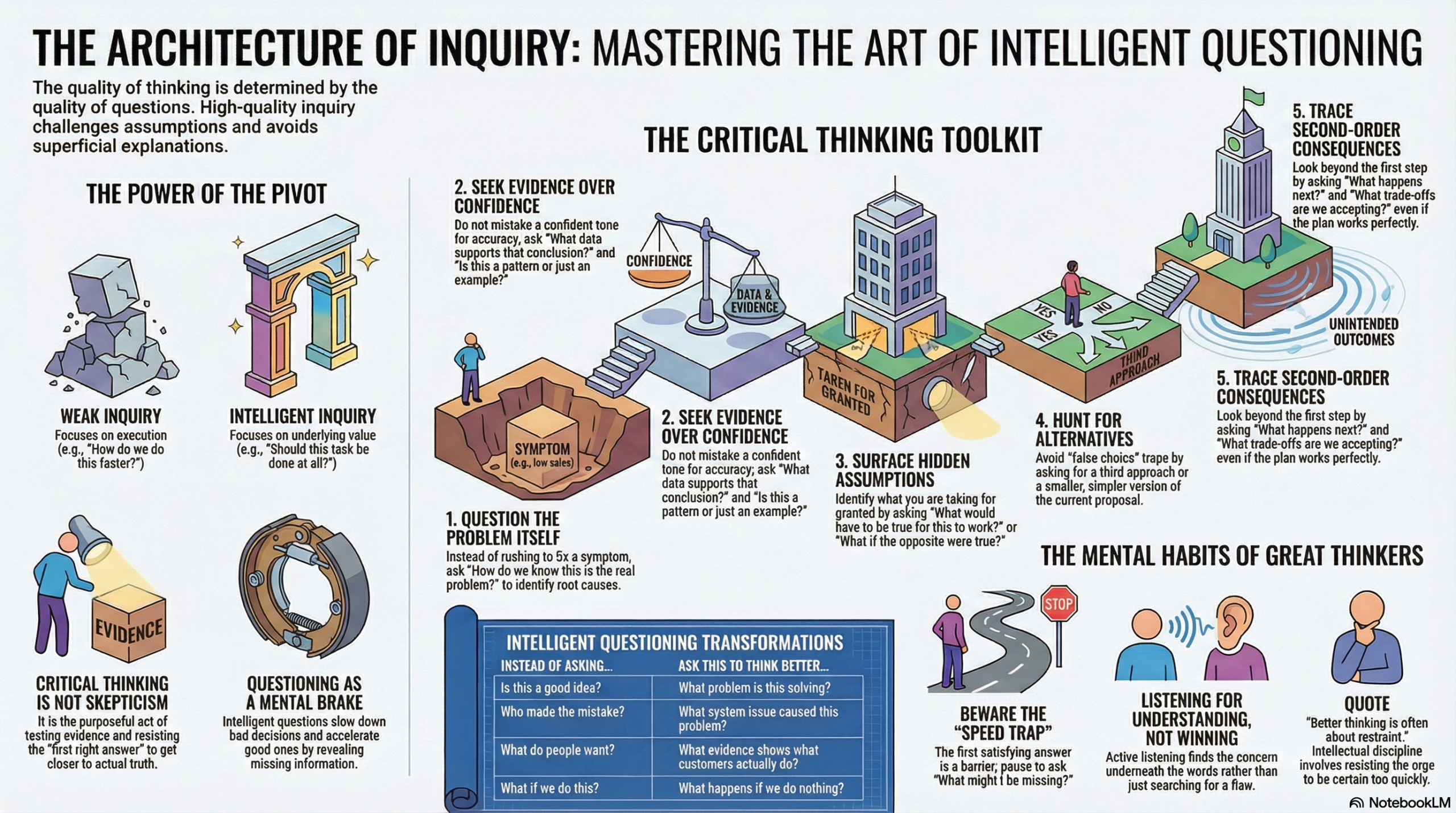
If you ask, “How do we do this faster?” you may get speed. But you may miss whether the task should be done at all. If you ask, “Who made the mistake?” you may get blame. But you may miss the system issue that caused the problem. If you ask, “What do people want?” you may get opinions. But if you ask, “What evidence do we have about what customers actually do?” you are more likely to get something useful.
Intelligent questions do not just collect information. They improve the direction of thought.
They help you move from assumption to understanding.
What makes a question intelligent
An intelligent question is not complicated. It is purposeful.
Usually, it does one or more of the following:
- clarifies the real issue
- tests an assumption
- asks for evidence
- explores alternatives
- reveals consequences
- exposes missing information
For example, instead of asking, “Is this a good idea?” ask:
- What problem is this solving?
- What evidence suggests this will work?
- What are we assuming here?
- What could make this fail?
- What are the alternatives?
- What happens if we do nothing?
These questions are better because they force clearer thinking. They move the conversation past opinion and into reasoning.
Start with the problem, not the surface
One of the most useful habits in critical thinking is learning to question the problem itself.
People often rush into solving the first version of the problem they hear. But the stated problem is not always the real one.
A team may say, “Sales are down, so we need better marketing.” But maybe the real issue is pricing, product quality, customer retention, or delivery delays.
A manager may say, “The team needs more discipline.” But perhaps expectations are unclear, workloads are unrealistic, or the system is badly designed.
A student may think, “I am bad at this subject.” But the actual issue may be poor study methods or lack of feedback.
Before asking how to fix something, ask what is actually happening.
Useful questions include:
- What is the real problem here?
- How do we know that is the problem?
- What are we treating as a fact that might only be an assumption?
- Are we looking at a symptom rather than a cause?
This is where critical thinking begins.
Ask for evidence, not just confidence
One of the easiest traps to fall into is mistaking confidence for accuracy.
People often speak with certainty even when their reasoning is weak. That happens in meetings, online discussions, news reporting, and everyday life.
Critical thinkers look past tone and ask for evidence.
That does not mean being hostile. It means being careful.
Try questions like:
- What is this based on?
- What data supports that conclusion?
- Is this an example or a pattern?
- Where did this information come from?
- How reliable is the source?
These questions help separate what is known from what is guessed.
They also protect you from being persuaded by strong language alone.
Challenge assumptions, including your own
Many poor decisions come from assumptions that go unnoticed.
We assume a process is necessary because it has always existed. We assume customers care about the same things we care about. We assume the loudest person in the room understands the issue best. We assume that because something worked before, it will work again.
Intelligent questions bring those assumptions into the open.
Ask:
- What are we taking for granted?
- What would have to be true for this to work?
- What if the opposite were true?
- Are we assuming too much from too little evidence?
The important part is that you apply these questions to yourself as well.
Critical thinking is not only about spotting weak logic in others. It is also about noticing your own bias, your own habits, and your own tendency to jump too quickly to conclusions.
That is what makes it difficult. It is also what makes it valuable.
Look for alternatives
A common sign of shallow thinking is false choice.
People act as if there are only two options when there may be five. They frame a decision as yes or no, win or lose, act now or fail. That kind of narrow thinking creates unnecessary pressure and often leads to poor judgment.
Intelligent questions open up the field.
Try asking:
- What other options are available?
- Is there a smaller or simpler version of this?
- What would a third approach look like?
- Are we choosing between two bad options because we have not thought hard enough?
This kind of questioning is especially useful in leadership, problem-solving, and conflict. It helps people escape rigid thinking and see possibilities they missed at first.
Follow the consequences
Good critical thinking does not stop at whether an idea sounds good. It asks what happens next.
That means thinking through consequences, trade-offs, and second-order effects.
For example, a company may cut costs quickly but damage service quality. A team may move faster but increase errors. A person may avoid a difficult conversation but create a bigger problem later.
Ask:
- What are the likely consequences of this decision?
- Who benefits and who is affected?
- What trade-offs are we accepting?
- What could go wrong even if this works as planned?
- What happens after the first step?
These questions help you avoid short-term thinking.
They also make decision-making more realistic.
Slow down your first reaction
One of the biggest enemies of critical thinking is speed.
Not speed in general, but mental speed that leads straight to certainty. The first answer that sounds right is often the one people want to keep. It feels efficient. It feels satisfying. It often feels correct.
But first answers are not always best answers.
A useful habit is to pause and ask:
- What might I be missing?
- What would someone who disagrees say?
- Is there another explanation?
- Am I reacting or reasoning?
This pause is small, but powerful. It creates room for thought before judgment hardens.
In many situations, better thinking is less about intelligence and more about restraint.
Listen properly
You cannot ask intelligent questions if you are not really listening.
Many people listen only long enough to respond. They wait for their turn, defend their view, or search for a flaw in the other person’s argument. That makes real understanding difficult.
Good questioning starts with real attention.
When listening, ask yourself:
- What is this person actually saying?
- What concern sits underneath their words?
- What do they mean that they have not stated clearly?
- What would help me understand this more accurately?
Then ask questions that show you are trying to understand, not just win.
That improves both the quality of the conversation and the quality of your own thinking.
Make questioning a habit
Asking intelligent questions is not something reserved for formal debates or major decisions. It can become part of everyday life.
You can use it when reading an article, sitting in a meeting, reviewing a proposal, solving a problem, or hearing a strong opinion.
Over time, certain questions become especially useful:
- What is the claim?
- What is the evidence?
- What assumptions are being made?
- What is missing?
- What alternatives exist?
- What are the consequences?
These questions are simple enough to remember and strong enough to improve almost any discussion.
The goal is not to become suspicious of everything. The goal is to become thoughtful about anything important.
Final thoughts
Asking intelligent questions and thinking critically are not separate skills. They support each other.
Intelligent questions lead to better thinking. Better thinking leads to better questions.
Together, they help you understand problems more clearly, evaluate ideas more carefully, and make decisions with more judgment and less guesswork.
In a world full of quick opinions and constant noise, that matters.
Because the smartest people are not always the ones with the fastest answers.
Very often, they are the ones asking the best questions.