

Digital transformation is still necessary. That has not changed.
What has changed is the level of patience organisations have for failure.
Over the past few years, too many transformation programmes have gone over budget, disrupted operations, weakened controls, or delivered far less value than promised. In many cases, the problem was not the technology itself. It was the way the transformation was approached. Recent examples, including Birmingham City Council’s troubled Oracle rollout and Valvoline’s disclosures around ERP-related control weaknesses, show the same basic lesson: transformation fails when leaders treat it as a system implementation instead of a business change.
So what is the ideal approach now?
It is not a massive, all-at-once technology programme. It is not a vendor-led roadmap built around software features. And it is not a rebranding exercise where every project becomes “digital.”
The ideal approach today is a staged, business-led transformation model that starts with outcomes, builds in operational readiness, and scales only what has already proved its value.
Start with the business problem, not the platform
One of the biggest reasons digital transformation fails is that organisations start with the system they want to install rather than the problem they need to solve.
That leads to programmes built around technology milestones instead of business results.
A better starting point is much simpler. Ask what needs to improve in measurable terms. That might be order cycle time, forecast accuracy, first-contact resolution, customer onboarding speed, working capital, or regulatory compliance. The target should be specific, owned by the business, and tied to value.
This sounds obvious, but many transformation efforts still struggle because the value case is too broad and the accountability too vague. Deloitte has pointed to strategic misalignment and poor value quantification as major causes of transformation underperformance.
Treat transformation as operating model change
This is where many programmes go wrong.
A new ERP, CRM, workflow platform, or AI tool does not create value on its own. Value comes from changes in process design, decision rights, controls, data quality, roles, and behaviours.
In other words, digital transformation is not mainly about digitising the existing business. It is about redesigning how the business operates.
That is why governance matters so much. Birmingham’s Oracle programme reportedly suffered from weaknesses in governance, internal capability, testing, data migration, and vendor management. Those are not side issues. They are the heart of transformation success or failure.
The practical implication is clear: every transformation should be run as a business programme with strong operational ownership, not as an IT delivery exercise.
Move in waves, not in one big leap
Large, single-event go-lives are now much harder to justify.
They create too much concentration of risk, especially when the organisation is already dealing with data quality problems, process inconsistency, or weak internal controls. When everything changes at once, teams lose the ability to isolate issues, learn quickly, and recover safely.
A better model is wave-based transformation.
Start with a limited number of high-value processes. Redesign them. Clean the data. Test real use cases. Train users properly. Measure results. Fix what does not work. Then scale.
That approach may feel slower at the start, but it is usually faster in the long run because it reduces rework, disruption, and expensive recovery programmes.
It also aligns with a growing view that organisations should separate value delivery from full core-system replacement wherever possible.
Fix the data before you automate the process
Many transformation leaders still underestimate the damage poor data can do.
Bad master data, weak integration logic, inconsistent definitions, and poor migration discipline can undermine even the best-designed platform. The same is true for controls. If the process design is weak and the control framework is unclear, new technology will often expose those weaknesses faster rather than solve them.
Valvoline’s ERP-related control issues are a good reminder that transformation risk is not only operational. It can also affect reporting, compliance, and governance if control design is not robust.
That is why the right order is usually this: simplify, standardise, clean, control, then digitise.
Not the other way around.
Put business, operations, data, and technology in the same team
Transformation breaks down when each function works in sequence.
The business defines requirements. IT configures the platform. Data teams clean up late. Risk and compliance review at the end. Operations inherit the outcome and are expected to adapt.
That model creates delays, gaps, and blame.
A stronger approach is cross-functional delivery organised around real business journeys such as order-to-cash, source-to-pay, service resolution, onboarding, or claims. These teams should include business owners, process experts, data leads, controls specialists, and technologists working together from the start.
This matters even more when AI is involved. McKinsey’s 2025 research suggests that stronger AI outcomes are linked to leadership oversight, workflow integration, better data foundations, KPI tracking, and clear human validation.
Invest properly in adoption
This is still one of the most neglected parts of digital transformation.
Leaders often assume that once the tool is ready, the organisation will adapt. In reality, adoption depends on training, communication, management support, role clarity, incentives, and confidence in the new process.
Gartner warned in 2025 that a large share of supply-chain digital adoption efforts would fail to deliver promised value because of underinvestment in learning and development.
That lesson applies far beyond supply chain. If people do not understand the new way of working, do not trust the data, or do not believe the process helps them do their job better, transformation stalls.
Adoption is not the final phase. It should be designed in from the beginning.
Keep internal ownership strong
Vendors and system integrators can be essential, but they should not become the de facto owners of the transformation.
Organisations still need enough internal capability to challenge assumptions, make trade-offs, judge risk, and act as an intelligent customer. When that capability is weak, programmes drift. Complexity gets accepted too late. Dependencies are missed. Leaders lose control of the outcome.
That is one of the clearest lessons from failed programmes. External support can help deliver change, but it cannot replace internal accountability.
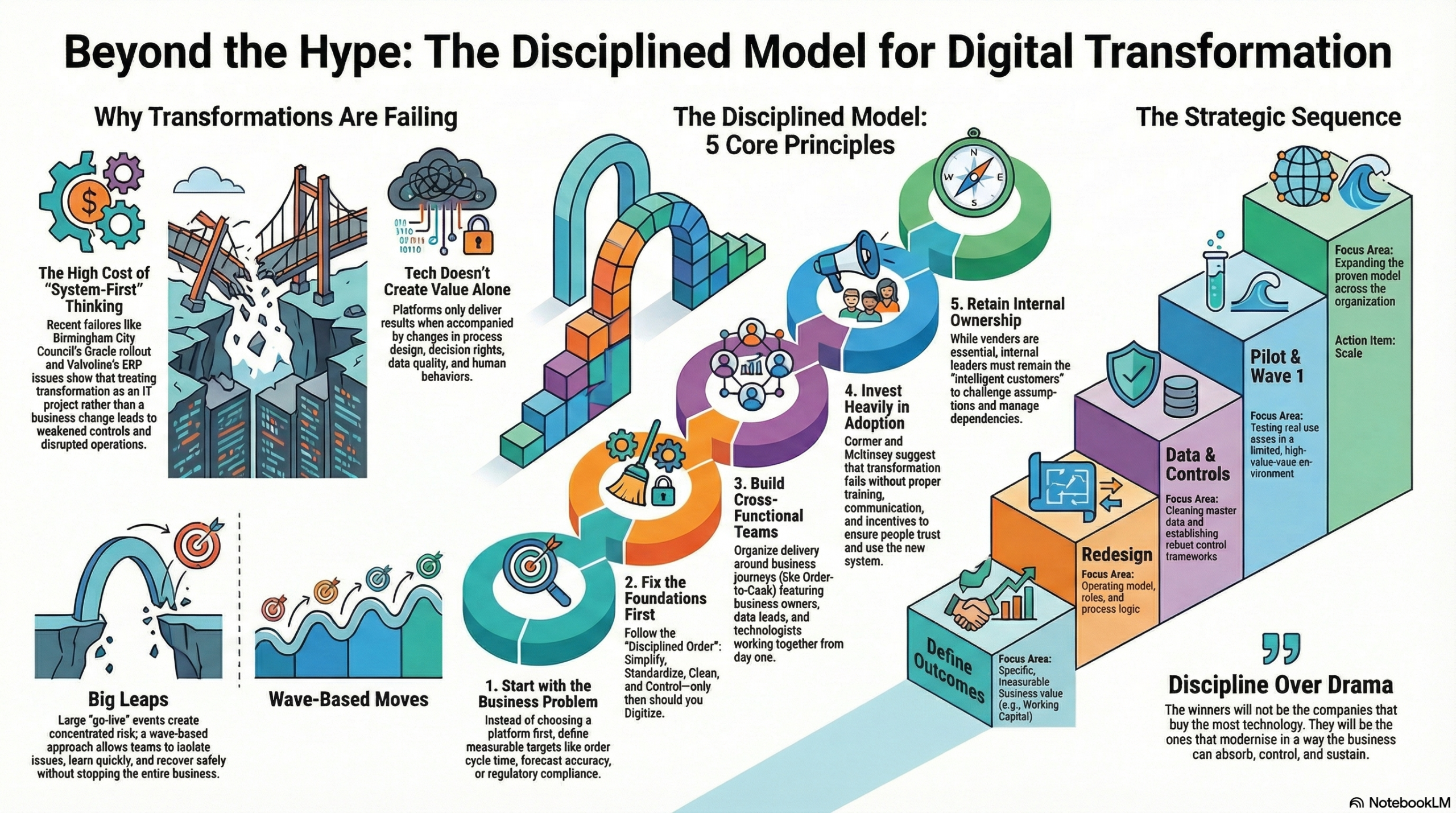
What the ideal model looks like
The ideal digital transformation approach today is disciplined rather than dramatic.
It starts with a small number of business outcomes that matter.
It redesigns processes before digitising them.
It treats data and controls as core foundations.
It uses cross-functional teams instead of functional handoffs.
It pilots before scaling.
It invests in adoption, not just implementation.
And it keeps ownership anchored in the business.
This is less exciting than a sweeping “reinvention” story. But it is far more likely to work.
Final thought
The era of large, technology-first transformation promises is fading.
Recent failures have made one thing clear: organisations do not need bigger digital ambitions. They need better transformation discipline.
The winners will not be the companies that buy the most technology. They will be the ones that modernise in a way the business can absorb, control, and sustain.
That is what good digital transformation looks like now.