

Failure Mode and Effects Analysis remains a core risk management tool, but in many organisations its application has not evolved at the same pace as the systems it is meant to assess. Traditional FMEA methods were developed for relatively stable products and processes. Today, teams work in environments shaped by rapid design changes, software-driven functionality, global supply risk, automation, and tighter regulatory expectations.
To stay useful, FMEA needs to move from a static documentation exercise to a more dynamic and integrated risk method.
Where Traditional FMEA Falls Short
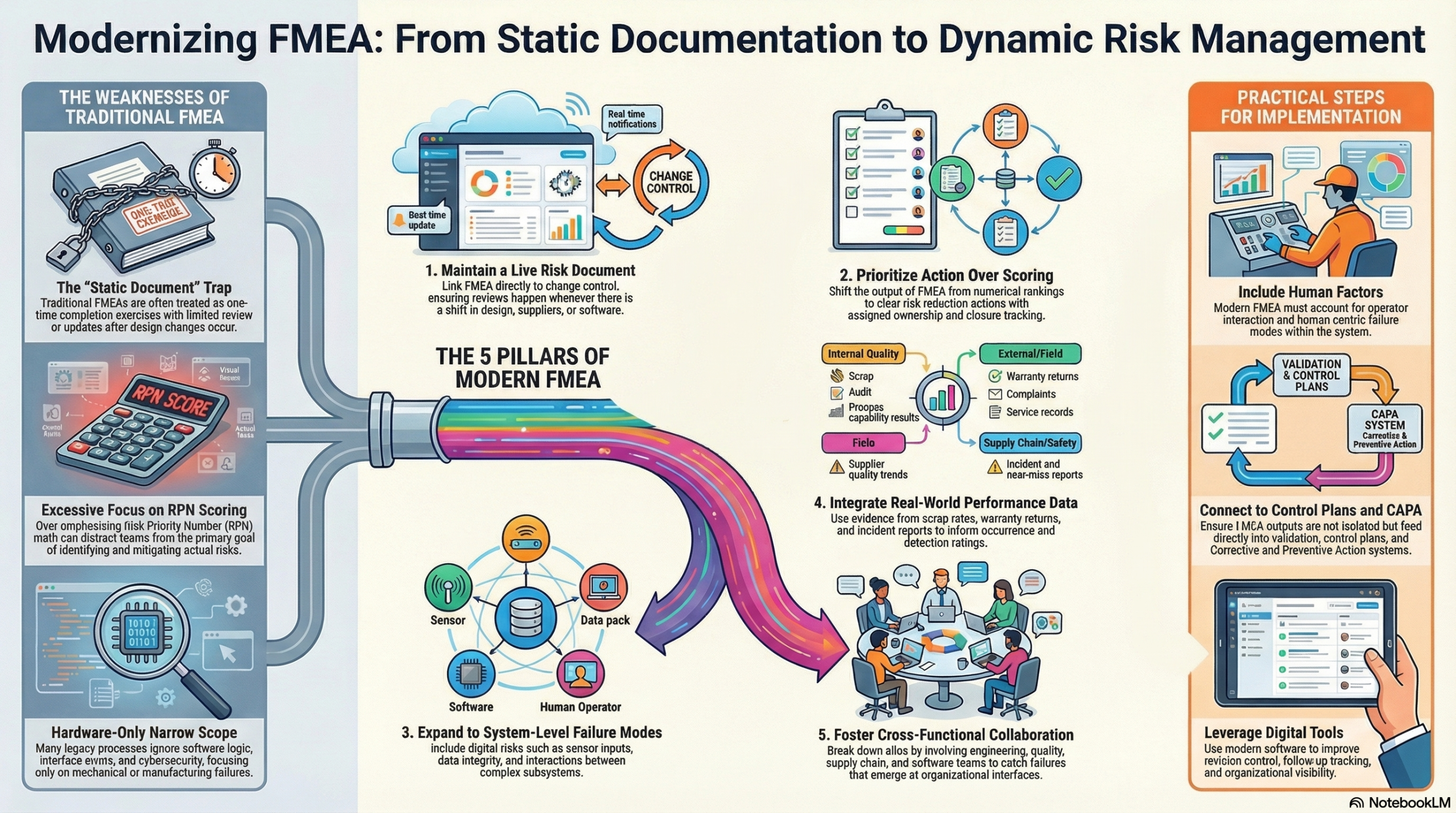
The main weakness in many current applications of FMEA is not the method itself, but how it is used. Common issues include:
- one-time completion with limited review after change
- excessive focus on Risk Priority Number scoring
- weak linkage between identified risks and corrective actions
- narrow application to hardware or manufacturing only
- limited use of field, quality, or process performance data
In a fast-changing environment, an FMEA that is not updated quickly loses value.
What a More Relevant FMEA Looks Like
A modern FMEA should reflect current operating conditions in five key ways.
1. It must be maintained as a live risk document
FMEA should be reviewed whenever there is a meaningful change in design, process, supplier, software, use condition, or field performance. Change control and FMEA review should be linked directly.
2. It should focus more on action than scoring
Severity, occurrence, and detection rankings are useful, but they are only a means to prioritise. The real output of FMEA should be risk reduction actions, ownership, and closure tracking.
3. It must cover digital and system-level failure modes
Many current failures are not purely mechanical. They involve software logic, sensor inputs, data integrity, interface errors, cybersecurity exposure, or interactions between subsystems. FMEA scope should expand accordingly.
4. It should use real performance data
Occurrence and detection ratings should be informed by evidence where possible, including:
- scrap and rework data
- warranty returns
- complaints and service records
- audit findings
- process capability results
- supplier quality trends
- incident and near-miss reports
This improves rating quality and makes the analysis more credible.
5. It must be cross-functional
Modern failure modes often emerge at organisational interfaces. Engineering, quality, operations, supply chain, software, service, and compliance teams should contribute where relevant. This reduces blind spots and improves action ownership.
Practical Improvements
To improve relevance, organisations should simplify and strengthen how FMEA is deployed:
- update FMEA through formal change management
- prioritise high-severity issues even when RPN is moderate
- include human factors and operator interaction
- connect FMEA outputs to control plans, validation, and CAPA systems
- use digital tools where possible to improve revision control and follow-up
Conclusion
FMEA is still a strong method, but only when applied in a way that matches current system complexity and business speed. A relevant FMEA is live, data-informed, cross-functional, and action-oriented. Organisations that modernise their FMEA process will get more than compliance value. They will improve prevention, detection, and overall operational resilience.